302 Labs
[ claire wang, davy deng ]
Whole Brain Emulation Needs a Benchmark oct 26
What would establish that a simulated brain is a faithful emulation? We argue that whole-brain emulation needs a shared benchmark that tests both a model’s predictions and the causal mechanisms behind them. We point out that WBE cannot be meaningfully progressed without scientifically rigorous metrics. We propose four levels of evaluation: representation, prediction, perturbation, and computational organization, and explore what these tests could establish about consciousness. Also, we detail why C. elegans is a concrete starting point.
In 2026, as several controversial claims of whole brain emulation (WBE) in Drosophila swept the internet, it became clear that WBE also needs a comparable way to test claims of ‘emulation’. If a WBE model is said to have created a brain in silico, what would establish that model had indeed succeeded? Every attempt at emulation involves choices about which biological details to preserve, approximate, or omit. With a carefully curated set of tests, we would investigate which details are necessary to preserve particular neural functions, where our measurements fall short, and the limits of what we can conclude about a model, including claims about consciousness.
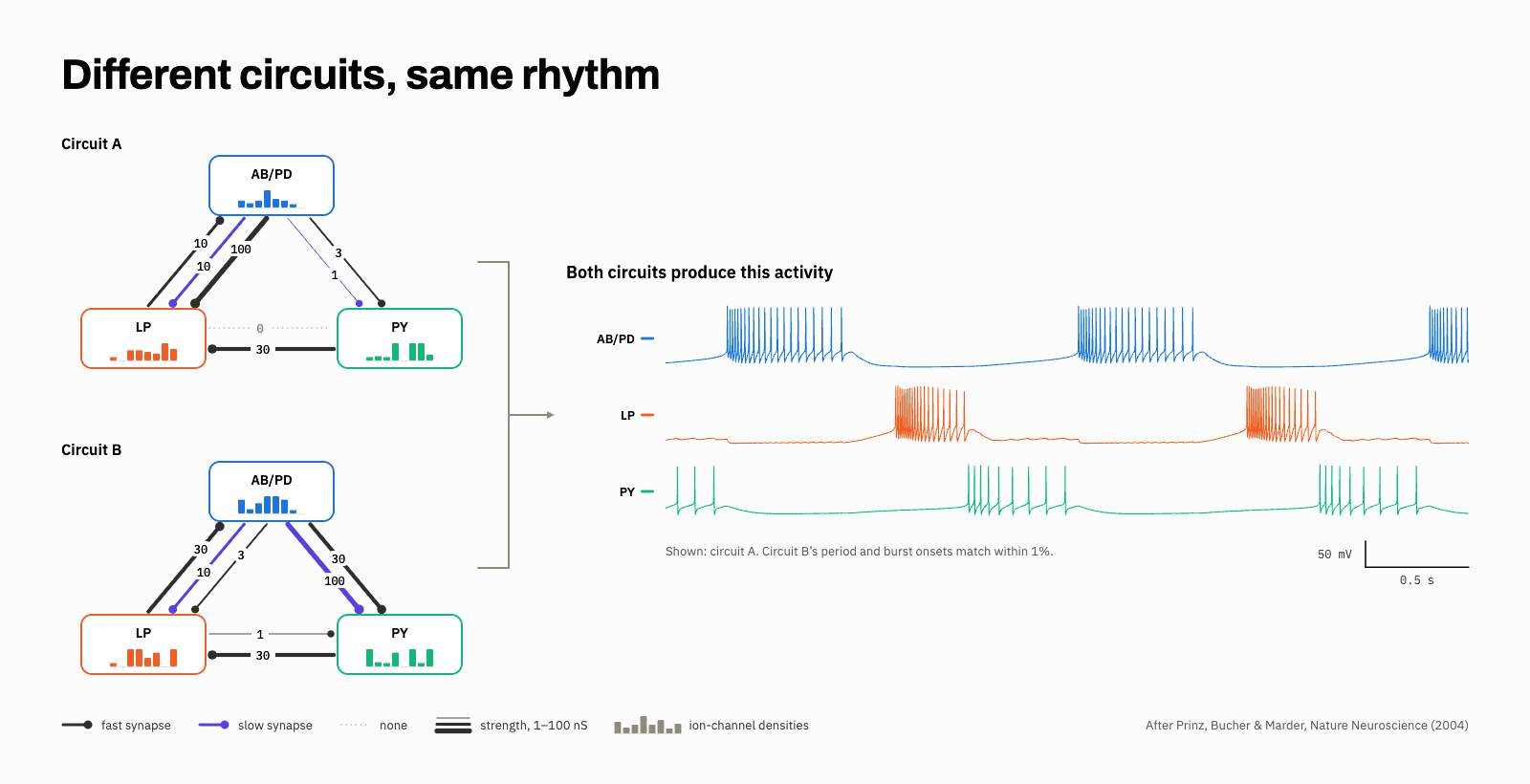
This is harder than you’d expect. A simulated animal might behave indistinguishably while having very different internal computations from its biological counterpart, or, it might reproduce recorded neural activity without matching any network structure of the real brain. In fact, in an influential 2004 paper, Prinz, Bucher, and Marder showed that even a 3-neuron network can have a basically infinite number of network structures with virtually identical neural activity [1] (Figure 1). These results have very practical consequences for the key distinction between WBE benchmark and traditional AI benchmarks: WBE must care about mechanistic fidelity in addition to prediction accuracy. However, that fidelity has yet to be defined and dissected in detail, leading to great confusion in the field about how exactly to design such a benchmark for informative evaluation. In this article, we aim to clarify this problem and offer a fruitful path forward.
What does matching a brain actually establish?
The 2026 releases of the fly brain connectome from Google and HHMI launched a flurry of viral videos of a fly moving in a virtual world. In these videos, a virtual animal can walk, feed, and navigate its surroundings similar to a real animal. As the colloquial goes, “If it looks like a duck, swims like a duck, and quacks like a duck, then it probably is a duck”, right?
This culture of focusing on model output (i.e., animal behaviors) resonates strongly in modern AI. Amid the explosion of progress in scaling AI, the emphasis lies in improving models' functional properties (such as reasoning or intelligence) rather than letting mechanistic interpretability catch up to explain the system’s internal structure. The strategy has paid off handsomely for many questions that have the shape of an AI task. For example, AlphaFold2 used a massive amount of protein structure datasets curated for five decades to solve almost every other protein structure in the universe.
However, for a successful WBE pursuit, this is a recipe for failure. For engineers of natural systems, it is highly unusual to build a stable, robust engineering system without understanding the intricate causal structure linking each internal component to the system’s ultimate performance. In neuroscience (and most other branches of science), the quest is usually entirely on mechanisms. We care about how the brain processes sensory input to generate intelligent responses and not just the responses per se. Similarly, we care about how the brain organizes its neural dynamics to actuate muscle cells for behaviors, and not just getting the behaviors themselves.
This distinction is key! The ultimate goal of uploading (probably) includes preserving an individual’s memories, dispositions, and ways of thinking. While a model may succeed in matching observed outputs such as patterns of speech or behavior, if it contains no constituent properties such as neural dynamics, neural representation, or a biophysically accurate interface between brain and body, it is unlikely to produce emergent properties of the brain such as emotions, cognitions, and consciousness.
How should we evaluate “upload” in the future?
Biological sciences are hard, to say the least. Scientists have argued for decades about what it takes to “understand” a messy, complex biological system. An influential article, provocatively titled “Can a neuroscientist understand a microprocessor,” [2] has provided pointed and uncomfortable warnings that we need a better formal description and mechanistic understanding of the biological world, or we risk confounding conclusions.
In contrast, modern neuroscience has largely ignored these lessons, as seen in some of the field's most prominent and popular evaluative metrics. Brain-Score evaluates similarity between model neural traces and real neural recordings across different visual inputs; Sensorium employs very similar metrics. Neural Latent Benchmark evaluates held-out neuron-activity predictions from recorded neuron activity. ZAPBench predicts future neural activity from past neural activity. These benchmarks can help evaluate a model's decoding/encoding ability (for applications in Brain-Machine Interface or neural prosthetics, for example) and can filter out models that fail to capture system dynamics, generalize poorly, or represent the space inaccurately, but they are not sufficient to identify mechanistic similarities. In other words, failure on the existing benchmark is definitive proof that the model is unbrain-like, but success on them is not proof that the model is brain-like. So what aspects or features help determine the mechanistic fidelity to a biological brain?
Here we propose that a well-designed benchmark should evaluate 4 levels, in increasing difficulty and rigor: representation, prediction, perturbation, and computational organization. The viral fly video had arguably reached 0-2 levels (unclear given lack of published data). A 5th level also matters: parameter identification, and is worth briefly discussing. The following section might be a bit technical for some readers, but we have provided examples and table summary to hopefully have it remain accessible (Table 1).
Representation and Prediction: These two layers have already been covered by existing benchmarks. Internal representation asks if a model organizes information the same way a brain does. Common methods such as Representation Similarity Analysis (RSA) and Centered Kernel Alignment (CKA) try to compare whether the high-dimensional neural activity contains similar internal representational geometry towards a variety of inputs. People can use RSA/CKA to compare different artificial neural networks or with real biological systems, but the similarity metrics only tell you whether the model encodes the input into its internal state space in a way comparable to the brain. It does not, however, identify individual neurons that do the computation or whether any model units correspond to real neurons; it does not evaluate if the dynamics of the neural response are correct; it also does not care if the representation to the input stimuli is used in any tasks or computation.
Prediction goes one step further. It evaluates the model’s neural responses and compares it with the actual neural recording dataset. It asks whether the model’s unit produces the right neural trace for “cat” and the right neural trace for “dog”, rather than just that the model can produce traces that are distinct for cat and dog. When neurons and model units cannot be identified one-to-one, benchmarks such as Brain-Score attempt to find the linear combination of model units that reproduce one biological neuron. In addition, prediction also often means prediction on unseen input, unseen neurons, and unseen timepoints, essentially asking the model to produce accurate neural dynamic traces that match real neural data.
Importantly, both representation and prediction are output-driven. It describes how well a model can produce output that is aligned with observational, passive recording data such as calcium imaging, fMRI, MEG, and electrophysiology. It never interrogates the model's internal causal structure or provides mechanistic evidence that the model implements the same computation as the brain to produce that output. As a result, a hypothetical model can score near perfect in representation and prediction metrics and yet contains an infinite number of mechanisms that are completely distinct from the real brain. In other words, these metrics are not sufficiently granular to evaluate cases where we demand computational fidelity (such as WBE).
Perturbation and Computational Organization: These two layers are currently missing in all existing neuroscience benchmarks. It has been widely acknowledged that a wide range of causal dynamical systems can produce identical dynamical trajectories. From an outside observer's point of view, this means the actual mechanism is underdetermined using passive data recording. The lack of identifiability becomes more serious as the network in question gets larger; the space of possibilities that all converge onto the same observed dynamics explodes, and the amount of required neural recording to disambiguate all the possible network geometries untenably scales. However, perturbation to the system reveals causal structure and greatly reduces the space of uncertainty of the input-output relationships, and thus is an essential tool to build causal neuroscience insights. Prior to optogenetics, transcranial magnetic stimulation (TMS) or environmental stimuli (such as chemical or physical stimuli) can be used to perturb the system away from equilibrium and watch its components interact to either enter a new state or collapse back to the original state. These are population-wide perturbations and therefore plagued with confounding variables. Optogenetics has greatly increased the precision of such perturbation to the single-neuron level, allowing researchers to infer the interactions between neural activity and behaviors much more accurately. Continuing with the cat and dog example, a benchmark that evaluates the model to predict behavioral responses to optogenetic perturbations will reveal whether the model can accurately identify the neurons responsible for the behavior of classifying cat and dog, and identify the effects of the neuron’s activity in determining the system’s classification of cat and dog.
However, that still does not count as causality because we cannot disambiguate the precise computation the neuron actually performed in order to reach the behavior. Computational organization is thus the final level, and it requires simultaneous optogenetic perturbation and calcium or voltage recording. This will allow you to not only see the linkage between the activity of a neuron to behavior, but also its route of information propagation from one neuron to another before ending in behavior. Strictly speaking, that optogenetic perturbation may also need to be combinatorial (such as multi-photon holography) or varying in amplitude and timing, to identify nonlinear interactions and remove ambiguous circuit mechanisms. A benchmark that evaluates computational organization will therefore know whether the model implements the identical computational algorithm as the brain to classify cat and dog.
Perturbation datasets are, however, sparse and their granularity varies across organisms, so depending on the model, researchers may evaluate the candidate model’s ability to predict interactions between neurons, neuron types, circuits, or brain regions.
Parameter Identification: This is an even higher fidelity requirement for an emulation model, but its necessity in WBE requires careful studies and remains to be determined. Parameter identification means not only does the model have to capture the computational algorithms of the brain, but it also has to use the exact same parameters (e.g., ion channel density, neurotransmitter time constant, etc.) that the brain uses. It would require patch-clamping and potentially a simultaneous optogenetic dataset, which is highly impractical and not scalable to even a small nervous system. It is unclear whether emergent properties that the WBE community cares most about, such as cognitive function, emotion, and consciousness, require these parameters to match or whether it is sufficient to match the computational algorithm these parameters participate in.
| Level | What it asks | Data modality needed | In current benchmarks | What a pass still doesn’t show |
|---|---|---|---|---|
| Representation (observational) | Does the model separate cat and dog the way the brain does? | Passive neural recordings (calcium imaging, fMRI, MEG, electrophysiology) | Yes | Which units match which neurons, whether the dynamics are right, or whether the representation is used for anything |
| Prediction (observational) | Does the model produce the brain’s actual response to “cat” and to “dog”? | Passive recordings (calcium imaging, fMRI, MEG, electrophysiology) | Yes | The causal mechanism, since infinitely many mechanisms can produce the same outputs |
| Perturbation (causal) | Does the model find the neurons that drive the cat/dog decision, and predict what happens when they’re perturbed? | Single-neuron optogenetic perturbation with a behavioral readout | No | What computation each neuron performs on the way to the decision |
| Computational organization (mechanistic) | Does the cat/dog signal travel from neuron to neuron along the same route, meaning the same algorithm? | Combinatorial optogenetic perturbation (multi-photon holography) with simultaneous calcium/voltage recording | No | Whether the algorithm runs on the brain’s actual parameters |
| Parameter identification (exact) | Does the model run that cat/dog algorithm with the brain’s exact parameters? | Patch clamp, possibly with simultaneous optogenetics (impractical even for a small nervous system) | No | Unclear whether WBE needs this level |
Evaluating Consciousness
The ultimate goal of many WBE builders is uploading consciousness. So it is worth a slight detour to discuss how specifically the field may be able to evaluate consciousness (along with emotions, perception, and other subjective psychological terms). Here we will assume a substrate-independent functionalist theory of mind. There is, of course, the substrate-dependent biological naturalist theory of mind, and because in that case, the concept of a “model” becomes very different, we will not discuss it here.
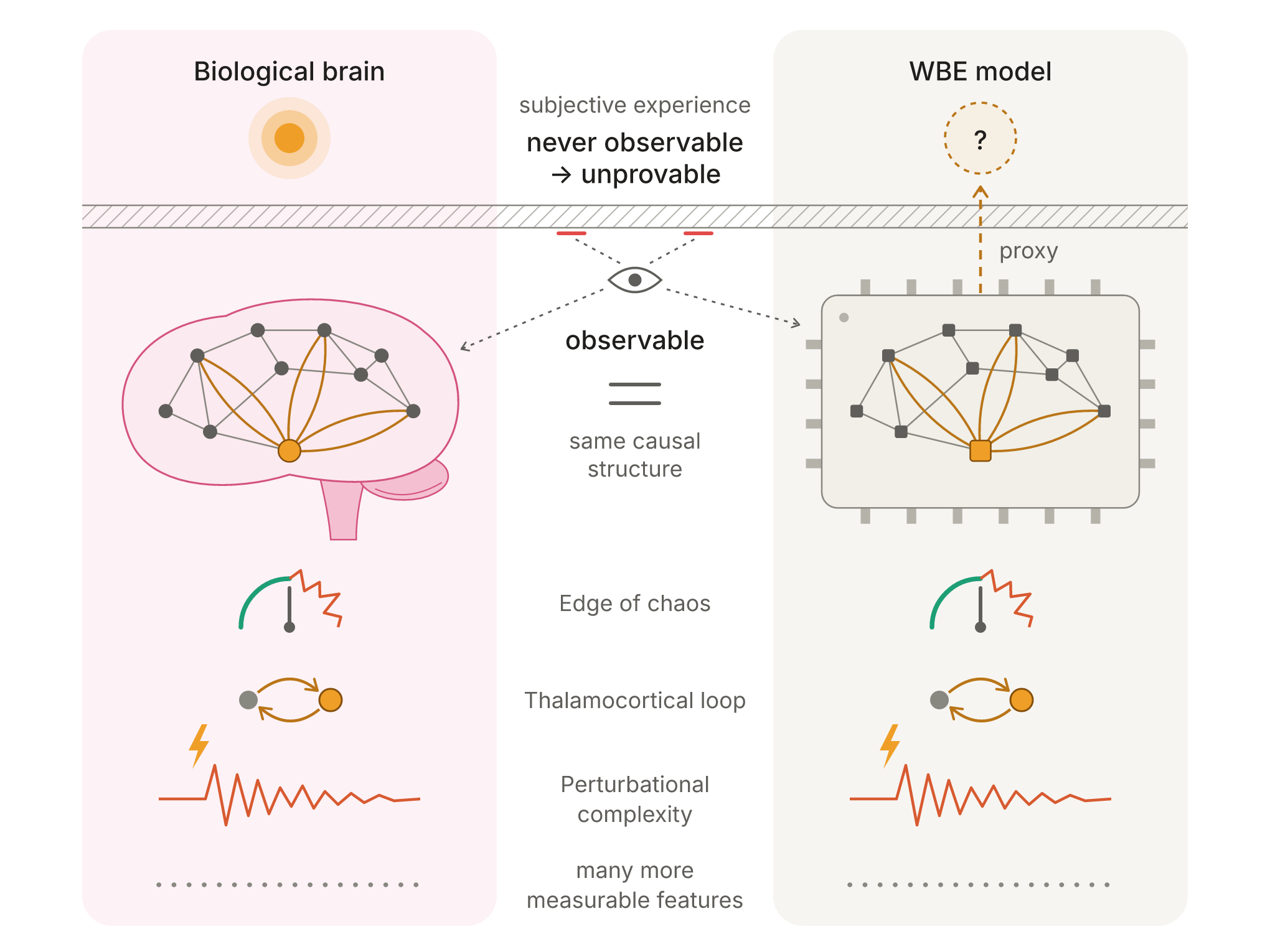
First, the phenomenological consciousness of any model is not just unknown but unknowable. We cannot access a person’s subjective experience because subjectivity is, by definition, not accessible to an objective outsider. Science rests on the ability to disprove hypotheses; therefore, evaluating whether a WBE model possesses phenomenological consciousness does not fall under scientific governance. However, we can talk about neurobiological signatures that can serve as strong indicators of consciousness. If a WBE model exhibits complete causal structure recapitulation (level 4 in our metrics) of a nervous system that we know to be conscious (e.g., fish, dogs, humans), then there is a strong reason to believe that the model should also capture that state of consciousness under the assumption of computational functionalism. More concretely, several distinct neural features spanning level 1-4 such as the edge-of-chaos dynamics, the recurrent interaction and activation of the thalamic-cortical loop, and perturbational complexity have been either correlated with or causally demonstrated to be associated with the state of consciousness in a brain [3-5] (Figure 2). Therefore, if a WBE model exhibits these features, it may be reasonable to infer consciousness from the model. In fact, this is one of the major reasons that motivate the need for a WBE benchmark, as existing benchmark criteria do not distinguish models that actually capture the computational organization of the brain.
What does this mean for the field of whole brain emulation?
A nascent scientific field needs certain prerequisite conditions to grow and flourish without devolving into pseudoscience. For WBE, hard technical requirements such as brain mapping, high-resolution neural recording, and precise neural modulation have progressed steadily to the point where a first demonstration of WBE is within reach. However, evaluative benchmarks with a suite of falsification tasks are currently lacking, preventing the field from maturing. A carefully designed and calibrated WBE benchmark will incorporate the 4 levels of mechanistic fidelity we discussed above, motivate the creation of ground-truth datasets, and guide future technology development to improve the model and scale to larger nervous systems. One critical challenge with the benchmark development is insufficient data coverage. Most of the data modalities required for evaluating perturbation and computational organization are vanishingly sparse in neuroscience, and building a complete dataset, especially in larger model organisms, will need further technological advancement. However, integrating fragmented datasets from literature across studies is one viable path forward to building a first version of the benchmark.
Such an endeavor also highlights the essential need for WBE researchers to have their methodology validated in a system with full comprehensibility.
Lessons from the Human Genome Project and Gemini
The Human Genome Project offers a useful precedent. Sequencing smaller organisms was part of the project’s strategy for developing the methods that were needed to eventually tackle the human genome. C. elegans, in fact, became the first animal to have its genome sequenced in 1998, and the techniques used for that effort helped accelerate human sequencing. The project leaders explicitly credited the worm as one reason they were able to bring the human completion target forward by two years.
NASA took a related approach in preparing for the Moon landing. Before Apollo, the Gemini program tested capabilities that lunar missions would depend on: prolonged human spaceflight, rendezvous, docking, and so on. These were concrete achievements that could be demonstrated on Earth orbit before being relied upon during a lunar mission. A previously overly ambitious destination became possible after a series of experiments with observable criteria of success.
C. elegans as a first model organism
What is our first model organism? For WBE, C. elegans is a promising place to develop a similarly demanding sequence of tests. Its small nervous system (the adult hermaphrodite has just 302 neurons!), identifiable neurons across animals, transparent body, and extensive anatomical resources make it possible to connect measurements across experiments. We can already stimulate identified neurons and record responses across much of the head nervous system, providing us with perturbation data that we can compare a model’s causal predictions against. Yet, the available data today remain incomplete. Completing and extending these measurements should become a shared priority.
Building a coordinated benchmark effort
A coordinated effort around the worm would be foundational to progress for human emulation. This effort should collect complementary datasets, establish shared benchmarks, and require models to predict experiments they were not built to reproduce. Its central question would be concrete: what information is sufficient to build a model that matches the animal across all 4 levels of computational fidelity? Answering that question would begin to make working on human emulation tractable, and a much clearer timeline would appear.
- Prinz AA, Bucher D, Marder E. Similar network activity from disparate circuit parameters. Nat Neurosci. 2004;7(12):1345-1352. doi:10.1038/nn1352
- Jonas E, Kording KP. Could a Neuroscientist Understand a Microprocessor? PLoS Comput Biol. 2017;13(1):e1005268. doi:10.1371/journal.pcbi.1005268
- Toker D, Pappas I, Lendner JD, et al. Consciousness is supported by near-critical slow cortical electrodynamics. Proc Natl Acad Sci U S A. 2022;119(7):e2024455119. doi:10.1073/pnas.2024455119
- Fang Z, Dang Y, Ping A, et al. Human high-order thalamic nuclei gate conscious perception through the thalamofrontal loop. Science. 2025;388(6742):eadr3675. doi:10.1126/science.adr3675
- Casali AG, Gosseries O, Rosanova M, et al. A theoretically based index of consciousness independent of sensory processing and behavior. Sci Transl Med. 2013;5(198):198ra105. doi:10.1126/scitranslmed.3006294